Bourbon vs Whiskey vs Scotch: What’s the Difference?
The difference between bourbon, whiskey and Scotch comes down to origin and ingredients. Bourbon is an American whiskey made from at least 51% corn, while Scotch is whisky made in Scotland, typically from barley.
Go back to knowledge archive
Grain spirits share a common foundation, but their ingredients, origin and production methods make them very different.
A simple rule is often quoted:
All Bourbon and Scotch are whiskies - but not all whiskies are bourbon or Scotch.
In this guide, we break down:
- What whisky actually is
- The difference between bourbon, Scotch and rye
- Why it’s sometimes spelled whisky and sometimes whiskey
What is the difference between Bourbon, Whiskey and Scotch?
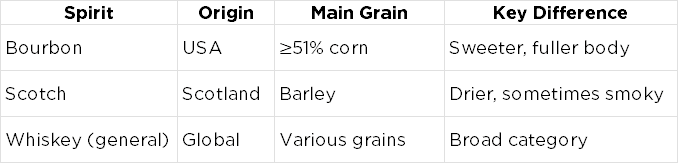
In short:
- Bourbon = American whisky made mostly from corn
- Scotch = whisky made in Scotland
- Whiskey/whisky = the overall category
What Is Whisky? (The Base Category)
Whisky (or whiskey) is a distilled and barrel-aged spirit made from fermented grain.
Common grains include:
- barley
- corn
- rye
- wheat
Each grain contributes different flavours:
- corn → sweetness
- rye → spice
- barley → malt and depth
This is why different whisky styles taste so different.
Curious about whisky's history? Find the article here.
Is It Whisky or Whiskey?
Both spellings are correct — the difference is geographical:
- Whiskey → USA and Ireland
- Whisky → Scotland, Canada, Japan, EU
The spelling doesn’t change the category; only the tradition behind it.
What Is Bourbon?
Bourbon is a type of American whiskey with strict legal requirements:
- Must be made in the United States
- Must contain at least 51% corn
- Must be aged in new charred oak barrels
Because of the corn content, bourbon typically has a:
- Sweeter taste
- Round, full body
The long version:
Bourbon is a type of whiskey that is made exclusively in the United States. Like Scotch, which can only be made in Scotland, bourbon can only be made in the United States and there are laws that stipulate, “No whiskey made outside the United States may be labelled bourbon”.
While bourbon can be made from anywhere within the United States, the alcohol is mostly associated state of Kentucky. According to reports, approximately 95% of all bourbon is produced in Kentucky.
Bourbon must be made from 51% or more corn grain and aged in new, charred American white oak barrels. There is no specified minimum period for its ageing. Due to its corn base, bourbon tends to be sweeter on the tongue. If you want to read ore about bourbon we have an article about that here.
What Is Scotch?
Scotch is whisky that must be:
- Produced and aged in Scotland
- Aged for at least 3 years
There are different types of Scotch:
- Single malt → made from 100% barley
- Grain whisky → can include other grains
Scotch is often:
- More dry
- Sometimes smoky (depending on region)
The long version:
It doesn’t take a huge leap of intuition to make the connection between Scotch and Scotland, and just as bourbon can only originate in the United States, Scotch can only be made in Scotland. The industry is regulated by the Scotch Whisky Association. When Scotch is made from 100 % barley, we can call it malt whisky. The legacy of Scotch can be dated all the way back to the 15th century, but it wasn’t until 2009 that the Scotch Whisky Regulations were established to define the rules and regulation around what can, and cannot, be labelled a Scotch. You can read our full article on the subject here.
What Is Rye Whiskey?
Rye whiskey is defined by its grain:
- Must contain at least 51% rye (in the US)
Typical characteristics:
- Spicy
- Dry
- More intense than bourbon
Rye regulations differ between:
- USA
- Canada
- EU
The long version:
In the United States, rye whisky must be made from a mash containing at least 51% rye, distilled to no more than 80% ABV, and aged in new charred oak barrels at no more than 62.5% ABV when filled. It cannot contain added flavoring or coloring, and if labeled “Straight Rye Whiskey,” it must be aged at least two years and declare the age if under four. Canada, by contrast, requires whisky to be mashed, distilled, and aged in Canada for a minimum of three years, but it may include added flavoring and caramel coloring and does not require a majority-rye mash.
In the European Union, whisky must be distilled below 94.8% ABV and aged at least three years in wooden casks up to 700 L, with caramel coloring permitted. However, due to the EU–Canada Agreement on Trade in Wines and Spirits, EU producers are prohibited from labeling their product as “Rye Whisky” unless it originates in Canada, as stated in Article 17(2): the EU “shall recognise Rye Whisky as referring only to spirit drinks originating in Canada and shall not permit the use of this name” for others. As a result, European distillers may make whisky from rye grain, but must use alternative descriptions such as “whisky made from rye.” Whisky Advocate writes more about that.
Other Whisky Styles (Quick Overview)
Japanese Whisky
- Inspired by Scotch traditions
- Must be produced and aged in Japan
Recently the Japan spirits and Liqueur Makers Association (JSLMA) introduced a set of rules defining Japanese whisky. It basically says that to label it Japanese Whisky it must be mashed, fermented, distilled and then aged for a minimum of 3 years in Japan. It does NOT, however, require the use of oak, just wood smaller than 700 litres. It also says barley MUST be part of the mashbill, which excluded smaller rice whisky producers. Read more here.
Nordic / Danish Whisky
- Emerging category
- Focus on innovation and local ingredients
- Growing international attention
Our article "What is Danish Whisky" dives further into the subject.
The work is still in progress, but first meetings have been held and the next years will hopefully see a rise in awareness. On a smaller but slightly more advanced scale, Danish whisky distilleries have signed (in 2025) a manifesto outlining, like Japanese Whisky, what requirements must be met in order to label a whisky "Authentic Danish Whisky". The focus is on innovation, different cask types, and new stills.
Main Differences Explained Simply
Bourbon → sweet, corn-based, American
Scotch → malt-driven, Scottish, often drier
Rye → spicy, bold
Whisky/whiskey → the overall category
Why These Differences Matter
Understanding whisky styles helps you:
- Choose the right bottle
- Understand flavour profiles
- Explore new styles with intention
Explore Whisky Further
If you want to go deeper you can find more articles here:
How do we make Danish Whisky?
- The products speak for themselves - you can find them below.
- If you find yourselves outside of the EU, we are available on all markets through Whisky Exchange.
FAQ: Bourbon vs Whiskey vs Scotch
What is the main difference between bourbon and whiskey?
Bourbon is a type of whiskey made in the USA with at least 51% corn.
Is Scotch a whiskey?
Yes — Scotch is whisky made in Scotland under strict regulations.
Why is it spelled whisky and whiskey?
The spelling depends on geography: Ireland and the US use whiskey, while Scotland and others use whisky.
Which is sweeter: bourbon or Scotch?
Bourbon is usually sweeter due to its high corn content.